
How Miami Arrests Become Records
An arrest inside the city might begin with the City of Miami Police Department, though MPD hardly works alone. Miami-Dade Sheriff's Office, Florida Highway Patrol, and campus, port, transportation, or federal agencies can each make arrests in Miami. Whoever made the arrest keeps the incident report, arrest affidavit, and probable-cause narrative, along with the case or incident number tied to the event.
County custody is different. Miami-Dade Corrections and Rehabilitation Department, or MDCR, runs the jail side, and most new detainees enter through Turner Guilford Knight Correctional Center. There the county confirms identity, takes fingerprints and a booking photograph, screens health, inventories property, enters charges, and assigns a custody classification. The county warns the process can take hours during busy periods. That lag is why MPD may know of a Miami arrest before the person surfaces in the county search.
Size adds context. Miami serves as the county seat and its largest city, with a 2023 Census estimate of 455,924 residents in the county's planning report. That number is population, not an arrest count. A dense urban core, heavy tourism, nightlife, big events, and major port and airport traffic mean varied police work, though none of that tells you who made a given arrest.
Where Miami Recent Arrests Appear
MPD publishes no daily arrest roster or city booking blotter. Its calls-for-service dataset is not a live arrest feed. The department's 24-hour incident log is an internal major-incident record with sparse details. It is not a public list of people or booking photos. Each channel holds a different kind of record. Use them for what they actually contain.
| Channel | Photo | Status | Best use |
|---|---|---|---|
| MDCR Inmate In-Custody Search | Official result may show one | Official | Current county custody and booking fields |
| MPD Records Unit | Request when held and releasable | Official | Miami arrest report, affidavit, or incident file |
| Miami-Dade Clerk CJIS | No booking gallery | Official | Case events and later disposition |
| MDSO newsroom and local news | Sometimes, source varies | Official or editorial | Selected events, not a complete feed |
| Third-party county archives | Often | Unofficial | Historical lead that requires official verification |
An official MDCR result can show name, date of birth, race, sex, custody location, charges, bond amount, jail number, booking date and time, and a mugshot. It is strictly an in-custody search. Released people drop off. New arrivals may still be processing. Images can be exempt or unavailable, and the roster never amounts to a complete history of Miami arrests.
Find Someone Arrested in Miami
Begin with what you know. That means the person's name, the likely arresting agency, and the rough date. Include any incident or jail number too. Similar names are everywhere in Miami, so match several fields rather than one. The county portal wants at least three characters. It accepts a last name plus a first initial or full first name.
- Search the official MDCR in-custody portal for current county custody.
- Compare the booking date, jail number, charges, and custody site. Treat each charge as an charge.
- If the arrest was recent, allow for transport and TGK intake, then check again.
- Ask MPD for the originating report when MPD made the arrest. Ask the actual arresting agency if another office made it.
- Use the Clerk’s CJIS search for the court case and its final disposition.
A blank result means several things. The person could still be in intake, already released, held outside MDCR, or never taken into county custody at all. It does not rule out a Miami arrest. For photo limits and what happens after release, see the county-wide booking-photo explanation.
A booking record is one piece of a case, not the whole file. Match what you find against the agency that holds it.
Miami Police Arrest Report Requests
For a report written by Miami police, the MPD Records Unit is the direct route. Include the incident number if you have it. Add the date and the location. Include the involved person's name and a clear description of the record wanted. Name the document too, whether arrest report, affidavit, incident report, or a releasable image. A narrow request helps the custodian find the right file and apply any lawful redactions.
City of Miami Police Department
400 NW 2 Ave.
Miami, FL 33128
Records Unit: 305-603-6477
Email: MPDRecords@miami-police.org
Public Information Office: 305-603-6420
MPD holds its own narrative; MDCR holds county booking and custody material. Want a booking record or county intake photograph? Go through MDCR's public-records route instead of asking MPD to copy a corrections file. If the sheriff's office or another department made the arrest, send the report request there. The court file sits somewhere else again. That is why treating one portal as the whole case never works.
Why Miami Arrest Photos Lag
The county's post-arrest process explains why a booking photo is never instant. A detainee rides to TGK first. Identity checks, fingerprints, photographs, medical and mental-health screening, property inventory, charge entry, and classification all follow. Intake can consume several hours. A city report and a county booking photograph run on different clocks.
Bond information may also look incomplete early on. Court activity, payment confirmation, classification, transfers, and release processing can each change a result after it posts. MDCR publishes no fixed daily posting hour. Trust the booking timestamp over any news publication time, and recheck when the arrest is very fresh. A report date, a booking date, and a court filing date can all differ. Nothing is wrong when they do. The official MDCR arrest-process page lays out this intake route step by step.
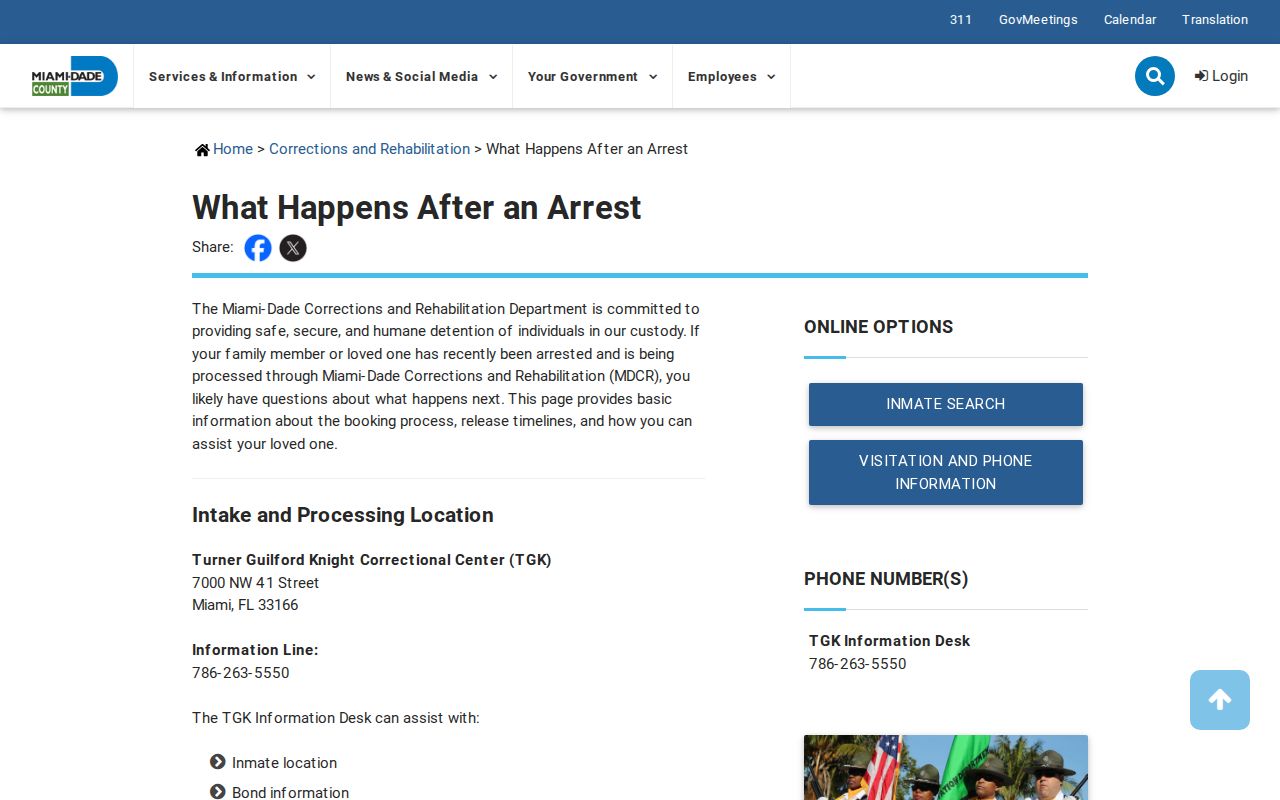
That page is a process guide, not a gallery of named Miami arrestees.
Miami Police Data Is Not Arrests
MPD publishes calls-for-service and records data going back to June 2017. The city refreshes it monthly for data from 2024 forward. A call for service is just that. It logs a request or a police response. No arrest is required for an entry to exist. So that dataset cannot replace an arrest report or an MDCR booking result, and it works best as incident context around Miami arrests.
Then there is the internal major-incident log. Department orders describe it. It holds date, time, unit, incident number, location, and a brief summary. Sensitive names get left out. Nothing in that requirement creates a public photo roster, and with no daily MPD blotter posted, the records request and the county search remain the official path.
Miami Arrest Coverage and News
Miami Herald Crime, Local 10, NBC 6, and WSVN all report on Miami arrests when a story is big enough. Their pieces draw on affidavits, police statements, court filings, jail records, and supplied images. Coverage stays selective. A story may run days after a booking. Publication dates are not booking dates.
Busted Newspaper runs a Miami city tag. Mugshots.com and Arrests.org keep Miami-Dade or Dade pages, and those pages sometimes attach city labels. These archives are unofficial. A record can linger after release. A city label may hide which agency made the arrest. RecentlyBooked lists no Miami-Dade section, so another Florida county should not be substituted.
MDSO's newsroom covers selected sheriff activity. It is not a complete Miami arrest log. For the report, custody status, and case outcome, the arresting agency, MDCR, and the Clerk still come first, even when local reporting adds helpful chronology.
Miami Arrest Records After Release
MDCR shows current county custody. Release changes the picture. The public roster may stop returning an entry even though the police report and booking record still exist. Ask MPD for the originating record. Ask MDCR for county booking material. For outcomes, search Miami-Dade Clerk CJIS and order a certified disposition when formal proof matters.
State prison is a different system. A person sentenced there, or placed under state supervision, belongs in the Florida Department of Corrections Offender Search, not the county roster. Federal Bureau of Prisons and ICE searches cover separate custody systems too. Match the source to the custody stage for the most reliable Miami arrest answer.
City of Miami Police Department Location and Directions
Public Record Search
Sponsored Results